|
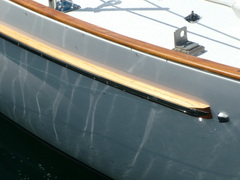 Adding a rub rail to the boat had its origin in a Sail article titled "Geezer Sailing". The assumption is that older guys are wise to modify their boats to make them more user friendly allowing us old guys to sail well into our "golden years." As I reviewed the suggestions, I found I had made all but one of the suggested changes already - I lacked only a rub rail. The author's logic was: if you are going to paint your boat, mostly likely paying a lot of money in the process, you should add a rub rail while you were at it. The rub rail would protect your investment, enhance the appearance of your boat and improve your docking skills (or their appearance) by allowing you to turn your boat on pilings as needed and not be afraid of hard landings on the the dock.
 I did not do this work myself. I could not for two reasons: 1) I was rehabbing my knees at that time and 2) I lacked the skills and experience to do this job. The rub rail is composed of white oak and a stainless steel rub strake. We chose to locate the rub rail on top of the cove stripe. Oak pieces were cut in appropriate lengths, cut on a diagonal, and scarfed together. The rail is attached to the boat by 1/4 inch bolts, placed on 8 inch centers, caulked and backed up with a washer and nyloc nuts. After the rail was attached, the rub strake was added. The white oak was treated top and bottom with two coats of Cetol Teak Natural. The inside of the rail was not Cetoled due to concerns about the Cetol interfering with the effectiveness of the caulk. Both the top and bottom edges of the rail were caulked to prevent water intrusion.
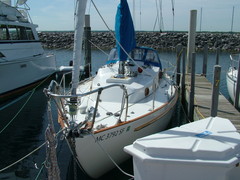 The rub rail works as predicted and was worth the time and money needed to get the job done. The only thing the rub rail does not protect against is errant anchors.
Dave Terrell, Scholarship II, #432


|