Mast
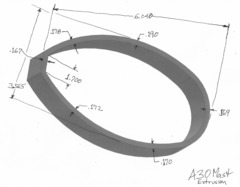
Thanks to John Maliszewski who digitized and annotated a section of the mast extrusion provided by Whitby as standard equipment. While this particular extrusion may not be commercially available, the dimensions here should make it easier to find a suitable replacement, if needed. Note that the actual thickness is a bit more than advertised. Hugh McCormack reports, "Our mast is 34 feet 9.25 inches from the cap to the bottom of the extrusion." According to Torresen Marine's site, the I dimension (height of the foretriangle from top of sheave to the sheerline) is 36 feet or 10.97 meters. BoomThe brochure specifies the boom extrusion as 5" by 3" of 0.108" aluminum. I measured 178.5 inches from the mast track to the middle of the eye on the end fitting. Spinnaker PoleThe Association bylaws limit the spinnaker pole or whisker pole (when racing) to the maximim J dimension of 10'9". For some reason, Torresen Marine's site specifies J (base of the foretriangle from the front of the mast to the intersection of forestay and deck) as 10.5 feet or 3.2 meters. Standing RiggingThe upper shrouds, forestay and backstay are 1/4" 1x19 stainless steel wire with 1/2" turnbuckles. The lower shrouds are 3/16" 1x19 stainless steel with 3/8" turnbuckles. The original main and jib halyards are a wire/rope construction with 5/32" flexible stainless steel wire spliced to 3/8" dacron 3-strand rope tails. Running RiggingThis has now been consolidated (somewhat) to a separate page. SailsOf course, you can use what you want if you're cruising. A good starting point would be the sail specifications in the Class Rules. These are also good cruising sails, and will let you race legally should you decide to do so. The P dimension and E dimension on the Torreson site are close, but not exactly the same as those in the class rules. The Chesapeake Bay Alberg 30 One-Design Association official apparel store.
|

|